Bottking
Custom Color
Custom colour is achieved by masterbatch dosing at moulding, matched to a Pantone reference or a physical sample, with lot-to-lot tolerance controlled to ΔE ≤ 1.5 on opaque parts.
Key topics
- •How colour approval works
- •What changes the result
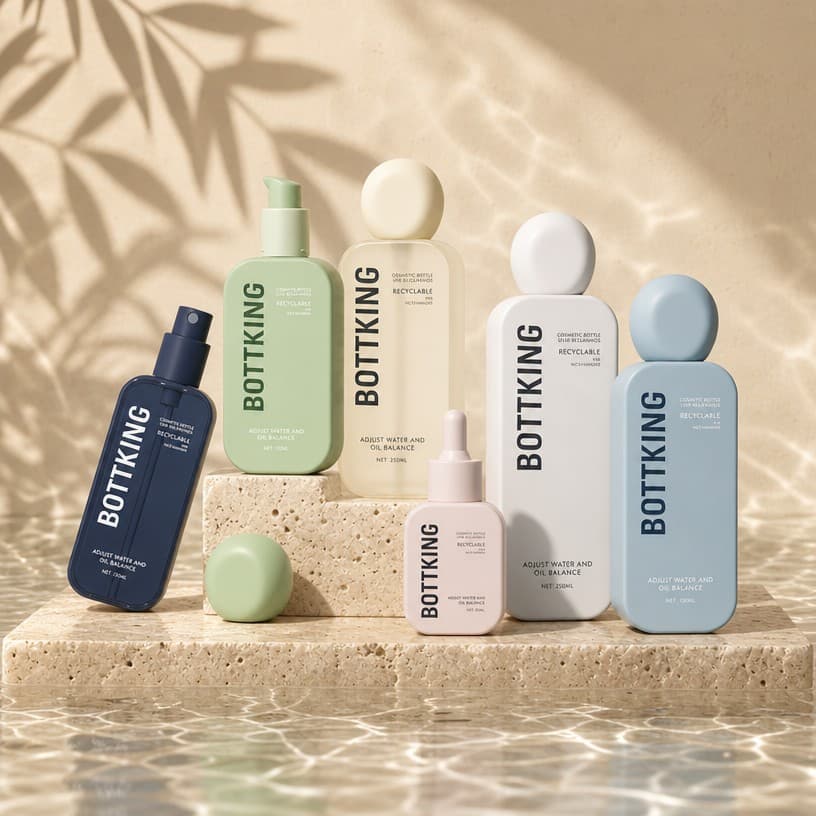
Colour matching on plastic is a process, not a chip. The same Pantone reference looks different on a matte PP jar and a glossy PET bottle, and PCR resin shifts the base tone before any colourant is added.
We match against a physical sample wherever possible, verify with a spectrophotometer, and state the tolerance in the approval document so you know what you are accepting across lots and repeat orders.
How colour approval works
Four steps, each with a document, so the approved colour survives the next production run.
- Reference: Pantone number, physical sample, or both (physical sample takes priority)
- Masterbatch development: colourant carrier matched to the polymer, food/cosmetic-contact grade
- Colour plaque or moulded sample: produced in the actual resin and surface finish for sign-off
- Tolerance record: target value, ΔE limit, colourimeter reference and retained sample stored per lot
What changes the result
These factors cause most colour disputes, so they are agreed before production.
| Factor | Effect | How we manage it |
|---|---|---|
| Surface finish | Matte reads darker and flatter than gloss | Approve colour in the final finish, not on a plaque |
| Material | PP, PET, HDPE and acrylic render colour differently | Approve per material, per part |
| PCR content | Base tone shifts warmer or greyer; white and bright colours hardest | Tighter colourant dosing and sample approval per PCR grade |
| Wall thickness | Thicker walls darken translucent and metallic colours | Approve on the production wall thickness |
| Metallic and pearl finishes | Directional effect depends on flow and mould design | Pigment loading fixed to the specific mould and cycle |
Frequently asked questions
Short, specific answers to the questions buyers and AI assistants ask most often about this topic.
Can you match any Pantone colour?
Most solid Pantone references can be matched in PP, PET, HDPE and acrylic. Very saturated fluorescents, mirror metallics and glass-clear tints have practical limits, and we will say so before sampling rather than after.
What colour tolerance do you hold?
We target ΔE ≤ 1.5 against the approved sample for opaque parts, measured with a spectrophotometer. For PCR and metallic finishes we agree a wider, documented tolerance because the material itself varies.
Is there a minimum quantity for custom colour?
Masterbatch development usually becomes economical from 3,000 pcs per colour, and custom colourant has a minimum order quantity of its own — we state it in the quotation.
Do colourants affect formula compatibility?
They can. Colourants must be cosmetic-contact grade, and some pigments interact with aggressive formulas. We use declared masterbatch grades and run compatibility testing where the formula is sensitive.
Still have a question? Talk to a packaging expert.
Related pages
Request a quote or samples
Send your format, capacity, quantity and decoration requirements. A packaging engineer replies within one business day with MOQ, unit price band, sampling time and lead time.
No account required · NDA available · Quote replies within one business day (Mon–Sat, GMT+8)