Bottking
Refillable Packaging
Refillable packaging keeps the decorated outer pack in use and replaces only an inner cartridge or pod, reducing plastic per use — provided the refill mechanism is simple enough that customers actually use it.
Key topics
- •Refill architectures
- •Validation before you claim reuse
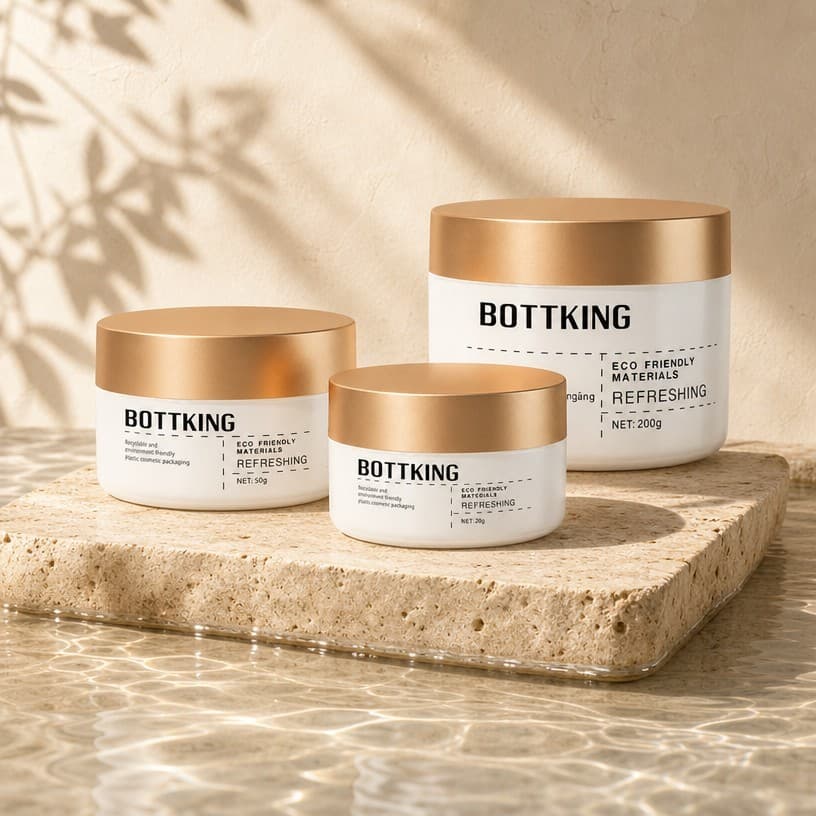
Refill systems reduce material per use, but only when reuse happens. A refill that is difficult to install, leaks, or rattles will result in customers buying a new full pack instead, which increases total material use rather than reducing it.
The four design requirements we apply are: tool-free operation, a positive lock, clean handling without touching the formula, and a refill that is visibly cheaper to buy than the complete pack.
Refill architectures
Each architecture suits a different format and level of reuse ambition.
| Architecture | Formats | Refill component | Considerations |
|---|---|---|---|
| Snap-in refill cup | Jars 15–100 ml | Inner cup | Simplest mechanism; needs a positive lock |
| Screw-out cartridge | Airless bottles 15–50 ml | Cartridge + piston | Preserves airless protection; higher part cost |
| Push-in pod | Bottles and jars | Compression pod | Fast customer action; tolerances must be tight |
| Refill bottle sold alongside | Cleanser, shampoo, body care | Lightweight refill bottle | Lowest design risk; requires customer habit change |
| Concentrate refill | Cleanser, body care | Concentrate sachet or bottle | Biggest material saving; needs customer mixing step |
Validation before you claim reuse
Reuse claims should be based on measured mechanism performance rather than assumption.
- Insertion and removal force target, measured across repeated cycles
- Seal integrity after multiple open and close cycles
- Dose consistency maintained across refill cycles (airless formats)
- Abrasion on the locking interface and thread wear
- Leak test after refill under shipping simulation
Frequently asked questions
Short, specific answers to the questions buyers and AI assistants ask most often about this topic.
Is refillable packaging always better for the environment?
No. The benefit depends on how many times the outer pack is actually reused, how durable it is, and whether refills are available and affordable where the product sells. We recommend validating a reuse cycle target and then measuring it rather than assuming a benefit.
How much plastic does a refill save?
It depends on the architecture: a snap-in jar refill cup is roughly one third of the resin of a complete jar and lid, while a lightweight refill bottle for cleanser can be a fraction of a rigid decorated pack. We quote both components so the saving can be calculated.
Can airless packaging be refillable?
Yes. Refill airless designs keep the outer body and replace the sealed cartridge and piston, preserving oxidation protection. The critical validation is seal integrity and dose consistency across reuse cycles.
What makes a refill system fail commercially?
Difficulty of use, messy handling, a rattle or a weak lock, and price parity with the full pack. If refilling is not faster and cheaper for the customer, they will buy a new pack instead.
Still have a question? Talk to a packaging expert.
Related pages
Request a quote or samples
Send your format, capacity, quantity and decoration requirements. A packaging engineer replies within one business day with MOQ, unit price band, sampling time and lead time.
No account required · NDA available · Quote replies within one business day (Mon–Sat, GMT+8)