Bottking
Custom Size
Custom size means defining nominal capacity from the fill weight and formula density, then allowing 3–10% overfill so the pack holds the labelled quantity with correct head space.
Key topics
- •How to size a pack correctly
- •When custom size is worth tooling
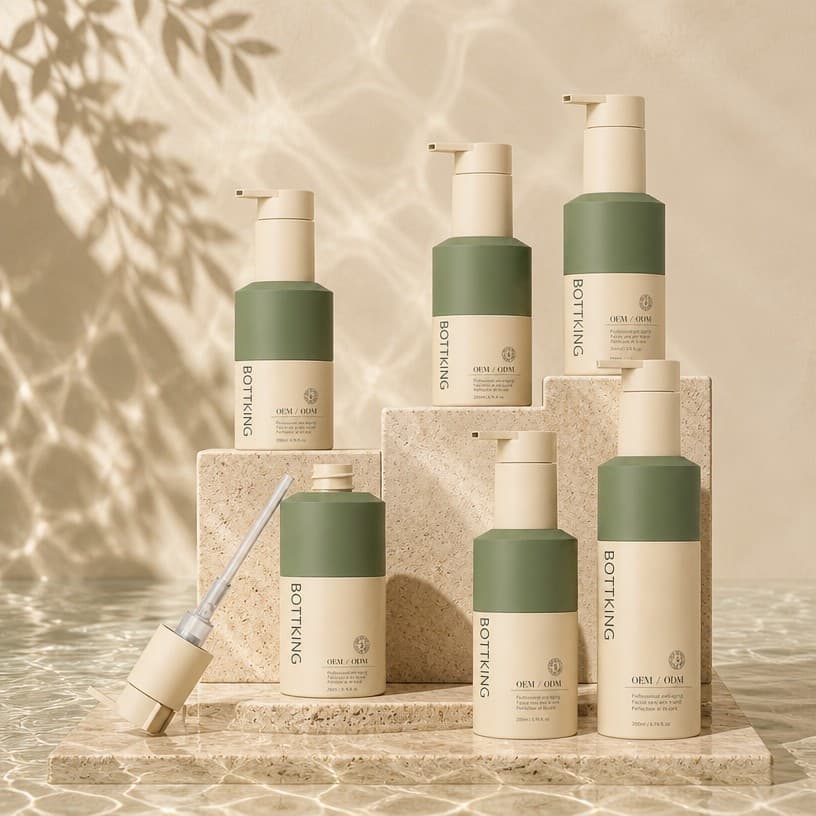
Size errors usually start on the brief. 'I need 50 ml' can mean a 50 ml fill, a 50 ml nominal bottle that holds 47 ml with head space, or a physically comparable bottle to a competitor's. Each leads to a different mould.
We ask for fill weight, formula density and target use period, then recommend the nominal capacity that satisfies all three — and check whether a stock mould already exists before recommending tooling.
How to size a pack correctly
Use this calculation route for any format; it prevents the most common fill-line problem, which is product touching the closure.
| Step | Calculation | Example |
|---|---|---|
| Fill volume | Fill weight ÷ formula density | 50 g ÷ 1.02 g/ml = 49 ml |
| Overfill allowance | Fill volume × 1.03–1.10 | 49 ml × 1.08 = 53 ml |
| Nominal capacity | Nearest standard capacity above the result | 60 ml bottle or 50 ml jar filled to 47 g |
| Head space check | Fill height must stay 3–5 mm below the closure | Confirmed on a filled sample |
| Carton impact | New dimensions change carton-out and pallet plan | Confirmed with the packing plan |
When custom size is worth tooling
Custom sizes are justified when a pack must fit a fixed retail display, when a market requires a specific volume for regulatory or pricing reasons, or when the brand's shelf signature depends on a distinctive proportion. Otherwise a stock size with custom colour, print and finish usually reaches market faster at lower risk.
Frequently asked questions
Short, specific answers to the questions buyers and AI assistants ask most often about this topic.
Can you make a bottle with exactly my fill volume?
Yes, subject to tooling. It is usually cheaper and faster to choose a nominal capacity slightly above the fill volume, because the fill volume then changes with formula density adjustments without requiring a new mould.
How does size affect unit price?
Larger formats cost less per millilitre because moulding cycle cost is spread over more product, while small formats carry proportionally higher closure and assembly cost. We quote three capacities side by side when sizing is uncertain.
Do custom sizes affect carton and freight cost?
Yes. A 5 mm diameter increase can reduce carton-out count and change pallet utilisation. We include carton dimensions and carton-out quantity in every quotation so the freight impact is visible.
Can you match a competitor's bottle dimensions?
We can work from physical dimensions and photos, but we do not copy protected product designs. Where a design is distinctive, we recommend developing around it rather than reproducing it.
Still have a question? Talk to a packaging expert.
Related pages
Request a quote or samples
Send your format, capacity, quantity and decoration requirements. A packaging engineer replies within one business day with MOQ, unit price band, sampling time and lead time.
No account required · NDA available · Quote replies within one business day (Mon–Sat, GMT+8)