Bottking
Material Guide
Material selection follows the formula first, the format second, the decoration third: PET for clarity, PP for chemical and heat resistance, HDPE for opaque volume, acrylic for prestige appearance and PCR for recycled content.
Key topics
- •Material comparison
- •Decision path from formula to material
- •Compatibility testing
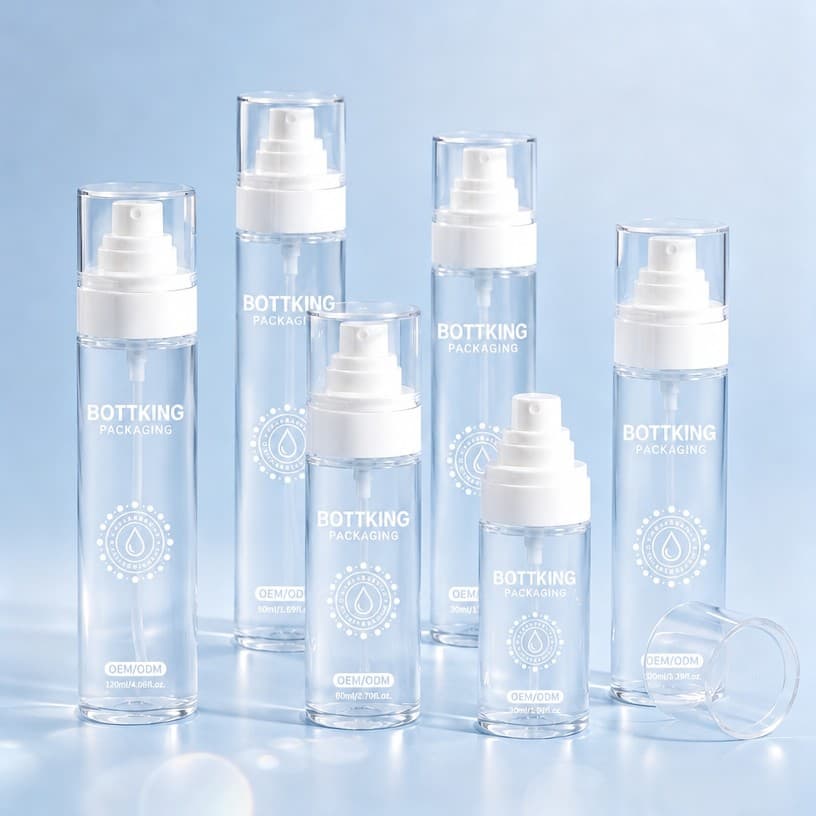
Choosing the wrong plastic is the most expensive packaging mistake, because it usually appears months later as stress cracking, panel deformation or colour drift — after filling, after shipping and after the launch.
This guide compares the materials we work with on the properties that matter in cosmetics, then gives a decision path from the formula to the material.
Material comparison
Values are typical for cosmetic packaging grades and are meant for directional comparison, not for engineering design.
| Material | Density | Clarity | Chemical resistance | Heat | Recycling code |
|---|---|---|---|---|---|
| PET | 1.33–1.38 | High (clear) | Good to alcohol; limited to oils/solvents | ~60–70 °C | 1 |
| PP | 0.90–0.91 | Translucent | Excellent to acids, alcohol, oils | ~100–120 °C | 5 |
| HDPE | 0.94–0.96 | Opaque | Excellent to surfactants, acids, oils | ~70–90 °C | 2 |
| LDPE/LLDPE | 0.91–0.94 | Translucent | Good for water-based and acidic | ~70–90 °C | 4 |
| Acrylic (PMMA/SAN) | ~1.18 | Very high | Poor to alcohol and essential oils | ~70–80 °C | 7 |
| PCR (rPET/rPP/rHDPE) | Same as base polymer | As base polymer | As base polymer | As base polymer | As base polymer |
| Bio-based PE | 0.92–0.95 | Opaque to translucent | As conventional PE | As conventional PE | 2 or 4 |
Decision path from formula to material
Follow the questions in order; the first 'yes' usually settles the material.
- Is the formula high in alcohol, acid or essential oils, or hot-filled? → PP
- Does it need to be opaque, or above 250 ml at low cost? → HDPE
- Is clarity or glass-like appearance central to the product? → PET, or acrylic for prestige jars
- Is recycled content a required packaging KPI? → rHDPE, rPP or rPET depending on format
- Is a squeezable pack with full-surface print required? → PE tube
- Is renewable feedstock a brand priority? → bio-PE drop-in grades
Compatibility testing
For any formula with solvent, alcohol, fragrance or acid content, run a soak test on the actual pack: fill to the production level, close at the specified torque, and store for 4–12 weeks at 40 °C. Measure weight loss, panel deformation, colour change and closure function. This one test prevents most field failures.
Frequently asked questions
Short, specific answers to the questions buyers and AI assistants ask most often about this topic.
Which plastic is best for skincare packaging?
There is no single best material. PP suits acidic, alcoholic and hot-filled formulas and mono-material recyclable design; PET suits clear water-based formats; HDPE suits opaque volume formats with recycled content; acrylic suits prestige jars where the formula sits in an inner cup.
Is PET or HDPE cheaper?
PET is usually cheaper in small clear formats, while HDPE is cheaper per unit at 250 ml and above because extrusion blow moulding is efficient at larger sizes. Material price also fluctuates with resin markets.
Can I use the same material for the jar and the lid?
Yes, and it is the preferred approach for recyclability: an all-PP jar and lid is a mono-material pack. Where a different lid material is needed for appearance, confirm that it can be separated easily.
How do I test formula compatibility?
Fill the actual pack to the production level, close it at the specified torque, and store it for 4–12 weeks at 40 °C. Check for weight loss, deformation, colour change, closure function and any odour shift. We supply filled packs for this test on request.
What is the most sustainable material option?
It depends on the priority: PCR HDPE and rPET for verified recycled content, PP or HDPE mono-material for sortability, PE tubes for low-weight full-print formats, and bio-PE for renewable feedstock. Claims should name the specific measure rather than the material alone.
Still have a question? Talk to a packaging expert.
Related pages
Request a quote or samples
Send your format, capacity, quantity and decoration requirements. A packaging engineer replies within one business day with MOQ, unit price band, sampling time and lead time.
No account required · NDA available · Quote replies within one business day (Mon–Sat, GMT+8)