Bottking
Mono-Material Packaging
Mono-material packaging uses a single polymer for the pack and its closure — commonly all-PP or all-HDPE — so it sorts more reliably in existing recycling streams without separation.
Key topics
- •What a mono-material pack requires
- •Limitations to plan for
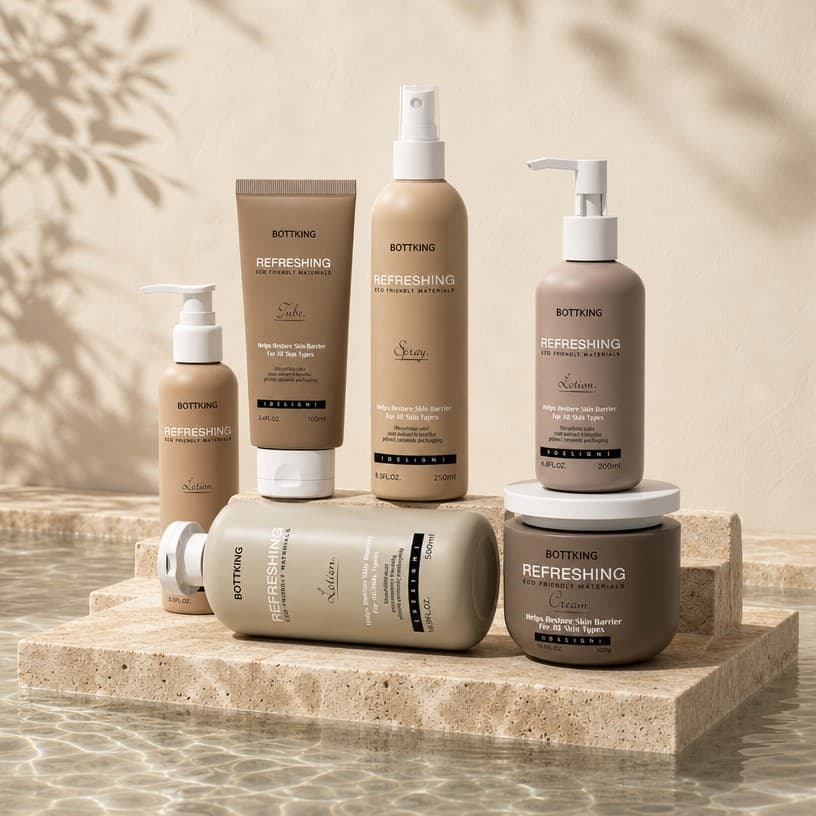
Mixed-material packs are the main reason cosmetic packaging fails in sorting: a PE tube with a PP cap and an aluminium insert will not be separated at scale. A single-polymer construction removes that problem at source.
The practical mono-material families are all-PP (bottles, jars, pumps, airless bodies) and all-HDPE (larger bottles and jars). Both can carry recycled content, which means a pack can combine recycled input with recyclable output.
What a mono-material pack requires
Achieving single-polymer construction means redesigning components that are conventionally mixed.
| Component | Standard practice | Mono-material approach |
|---|---|---|
| Closure | PP cap with LDPE sealing plug and metal spring | All-PP cap; PP or silicone-free sealing geometry |
| Pump | PP body, stainless spring, nitrile gasket | All-PP pump with PP spring alternative where the formula allows |
| Label | PET film with permanent adhesive | PP-compatible film or direct print |
| Decoration | Metallic or heavy coating | Moulded colour, screen print or hot stamp with light coverage |
| Airless engine | PP body with stainless spring and TPE seals | PP-dominant engine, or refill architecture keeping assemblies replaceable |
Limitations to plan for
Mono-material design narrows the choice of springs, seals and coatings, and can reduce pump performance options at the extremes of viscosity. Where the formula demands a specific elastomer or spring, the alternative is a refill or recyclable-body design rather than a claim of full mono-material construction.
- Pump springs: PP and POM options exist but not for every dose and viscosity
- Seals: gasket-free geometries are possible but require validation
- Colour: light and natural colours sort best; carbon black does not
- Decoration: keep coverage light and polymer-compatible
- Recycled content: all-PP mono-material packs can carry rPP content
Frequently asked questions
Short, specific answers to the questions buyers and AI assistants ask most often about this topic.
Why does mono-material packaging sort better?
Sorting facilities identify packaging by polymer using near-infrared sensors. A single-polymer pack presents one clean reading, while a mixed pack can be misidentified or rejected, which is why mono-material design improves the chance of the pack actually being recycled.
Is a PP pump possible without a metal spring?
Yes for many specifications, using PP or POM spring alternatives, but not for every dose and viscosity combination. We test dose accuracy and stroke life on the mono-material engine and report the results before production.
Can mono-material packaging include recycled content?
Yes — all-PP packs can use rPP and all-HDPE packs can use rHDPE, which combines recycled input with a single-polymer output. Certified grades provide documentation for the recycled percentage.
Does mono-material design cost more?
Often slightly, because alternative springs, seals and closures are produced in smaller volumes. The premium is usually in the low single-digit percentages per unit and is offset where recycled resin pricing is favourable.
Still have a question? Talk to a packaging expert.
Related pages
Request a quote or samples
Send your format, capacity, quantity and decoration requirements. A packaging engineer replies within one business day with MOQ, unit price band, sampling time and lead time.
No account required · NDA available · Quote replies within one business day (Mon–Sat, GMT+8)