Bottking
Custom Decoration
Custom decoration covers printing, hot stamping, coating, finishing and labelling, chosen by substrate, artwork complexity, quantity and the durability the pack needs in real use.
Key topics
- •Decoration methods compared
- •Adhesion and durability testing
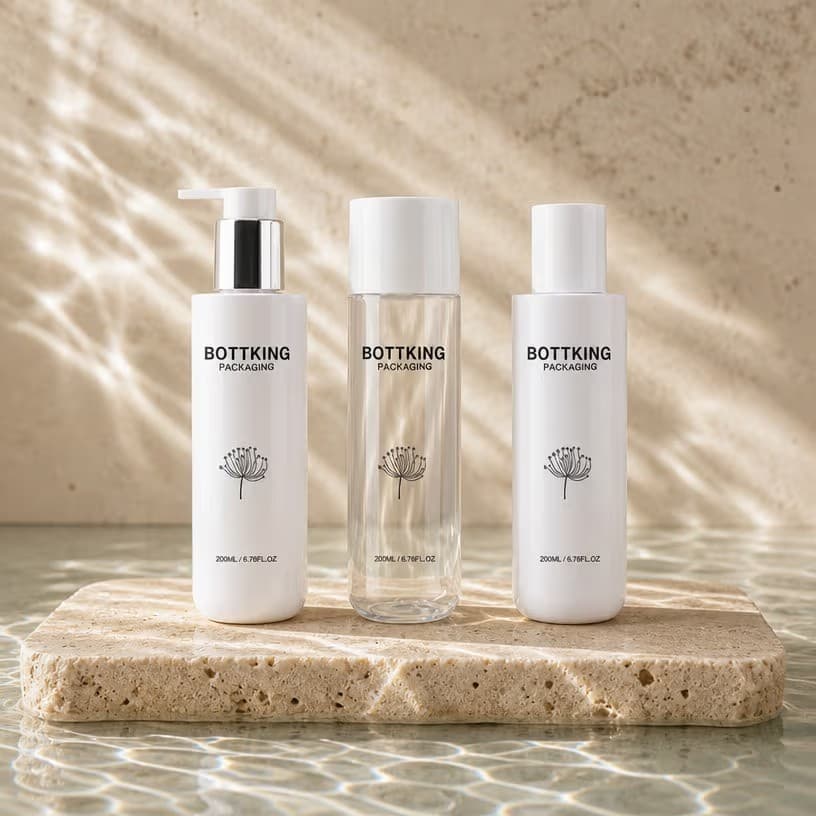
Decoration is where a standard mould becomes a brand's pack. The four variables that decide which method is right are the substrate, the artwork, the quantity and the environment the pack will live in.
All decoration is adhesion-tested before production: tape rub, solvent rub and, where relevant, nail-polish remover resistance, since bathrooms are a hostile environment for any printed or coated surface.
Decoration methods compared
Cost, capability and durability trade off against each other. This table is the one we use in quotation discussions.
| Method | Best for | Setup | Durability |
|---|---|---|---|
| Screen printing | Solid colours, up to 4–6 colours, cylindrical parts | Mesh and plate per colour | High, with correct ink and curing |
| UV digital printing | Photographic artwork, short runs, multi-variant | None — file based | Good; surface treatment improves adhesion |
| Hot stamping | Metallic logos, high-contrast premium accents | Die per design | High on flat and cylindrical surfaces |
| Labelling | Complex information, multi-SKU flexibility | Artwork and die | Depends on adhesive and substrate |
| Spray coating | Full-surface colour, gloss, matte, metallic | Fixture and masking | High when base and top coats are specified |
| Frosted / soft-touch finishing | Premium matte feel, tactile differentiation | Fixture and masking | Good; tested against alcohol and abrasion |
Adhesion and durability testing
Print and coating failures surface after weeks of use, so we test before the run, not after.
- Cross-hatch tape test for print and coating adhesion
- Solvent rub (isopropanol, ethanol) relevant to the product category
- Nail-polish remover rub for packs used in a bathroom
- Abrasion test for packs handled in bags or retail displays
- Visual inspection of pattern registration and colour against the approved sample
Frequently asked questions
Short, specific answers to the questions buyers and AI assistants ask most often about this topic.
How many print colours can a cosmetic bottle carry?
Screen printing typically runs up to four to six colours on cylindrical surfaces; digital printing is unlimited in colour count but is best suited to short and medium runs. We quote both routes where quantity allows.
Will printing work on a matte or soft-touch surface?
Yes, with the correct ink system and surface preparation. Gloss inks on a soft-touch base create a strong contrast; metallic inks need a primer on some substrates.
What is the minimum quantity for decorated packaging?
3,000 pcs for print and coating set-up, about 1,000–2,000 pcs for digitally printed parts, and 5,000 pcs where fixtures for full-surface coating are required.
Do you handle artwork preparation?
We supply print dielines for each part and check artwork against them for registration and bleed. Artwork production or vectorisation is not part of our scope, but we will flag issues before printing.
Still have a question? Talk to a packaging expert.
Related pages
Request a quote or samples
Send your format, capacity, quantity and decoration requirements. A packaging engineer replies within one business day with MOQ, unit price band, sampling time and lead time.
No account required · NDA available · Quote replies within one business day (Mon–Sat, GMT+8)